Note: Opening date for this clinic is TBD and is currently in development.
Our Approach
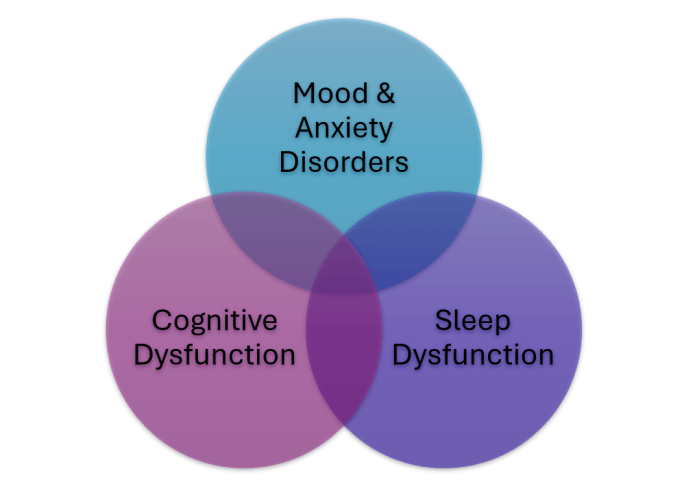
This clinic specializes in providing comprehensive, integrated care at the critical intersection of sleep disorders, mental health, and cognitive function. We recognize that sleep, mental health, and cognitive performance are deeply interconnected. Our team of expert psychiatrists, sleep specialists, and psychologists work collaboratively to develop tailored treatment strategies that address the unique needs of each patient.
The intricate relationship between sleep issues, mood and anxiety disorders, and cognitive dysfunction forms a complex web of interactions that can significantly impact an individual’s overall well-being. These conditions often overlap and exacerbate one another, creating a challenging cycle for those affected.
Our Services
- Comprehensive sleep assessments including referrals for sleep studies.
- Development of personalized treatment plans for sleep and mental health disorders
- Neurocognitive assessments including focused ADHD assessments
- Psychiatric assessments for mood and anxiety disorders across the lifespan (ages 14 and above).
- Neuropsychiatry assessments for post-concussion syndrome
- Cognitive Behavioural Therapy for Insomnia and ADHD Coaching
Patient Referral (not currently open)
Patients can be referred by family physicians or specialists. We work closely with healthcare providers to ensure comprehensive, coordinated care. In order to better serve the needs of the community and reduce long wait times, we do not provide long-term follow-up but rather follow an episode of care model for complex cases and consultation only model for less complex cases.
SOME BACKGROUND
Sleep and Mood Disorders
Sleep disturbances and mood disorders, particularly depression, have a strong bidirectional relationship. Insomnia is not only a common symptom of depression but can also increase the risk of developing major depression. Studies have shown that 15-20% of people diagnosed with insomnia may develop major depression. Conversely, individuals with chronic insomnia are five times more likely to develop depression. In bipolar disorder, alterations in sleep and circadian functioning are well-documented. Sleep deprivation has been shown to trigger manic or hypomanic episodes in some individuals with bipolar disorder, highlighting the critical role of sleep in mood regulation.
Sleep and Anxiety
Anxiety disorders are closely linked to sleep problems. The relationship between anxiety and insomnia is often cyclical, with anxiety contributing to poor sleep, which in turn exacerbates anxiety symptoms. Anxiety sensitivity, particularly cognitive concerns related to anxiety, has been associated with various sleep impairment domains.
Cognitive Function and Sleep
Sleep disturbances can significantly impact cognitive function, particularly in areas mediated by the prefrontal cortex (PFC). These cognitive deficits are observed in both individuals with mood disorders and those experiencing sleep deprivation, suggesting overlapping neurobiological mechanisms.
The Interplay of Sleep, Mood, and Cognition
The prefrontal cortex plays a crucial role in the intersection of sleep, mood, and cognitive function. Abnormalities in PFC functioning are observed in both mood disorders and sleep disturbances, affecting higher-order cognitive and emotional processing. This overlap suggests that sleep disruption may contribute to the cognitive and emotional processing deficits seen in mood disorders through shared neurobiological systems.
The Vicious Cycle
Poor sleep can lead to daytime dysfunction, including decreased concentration and diminished performance capacity. These cognitive impairments can, in turn, contribute to increased anxiety and depressive symptoms. The combination of sleep issues, mood disturbances, and cognitive problems can create a self-perpetuating cycle that is difficult to break without intervention.

Image from Sleepfoundation.org
Treatment Implications
Recognizing the interconnected nature of these issues is crucial for effective treatment. Targeting sleep problems in individuals with mood disorders may not only improve sleep but also enhance overall treatment response. Cognitive Behavioural Therapy for Insomnia (CBT-I) and other sleep-focused interventions may be beneficial in addressing both sleep and mood symptoms.In conclusion, the overlap between sleep issues, mood and anxiety disorders, and cognitive problems is substantial and multifaceted. Addressing these issues comprehensively, rather than in isolation, may lead to more effective treatment outcomes and improved quality of life for affected individuals.
Recent publications
- Managing comorbid sleep issues in patients with attention-deficit/hyperactivity disorder. https://www.cmaj.ca/content/cmaj/197/12/E323.full.pdf
 Toronto Sleep, Mood & Mind Clinic